a new blog for SPARC by Sarah Skagen
Life in 2026 is busy. Many of us juggle multiple jobs, a side hustle, children, aging parents, volunteer commitments, and the endless list of everyday responsibilities that somehow never seems to get shorter. Somewhere along the way, we've also been told to prioritize "self-care." At its best, self-care is about rest, health, and tending to our well-being. At its worst, it has become something we can buy in the form of another product or procedure promising confidence if we're willing to spend enough money. Our social media feeds are filled with influencers living carefully curated lives that make ordinary living seem inadequate. It's easy to fall into the trap of believing we're always one purchase, one routine, or one achievement away from finally becoming the person we're supposed to be.
While we're trying to keep up, our schedules have become more full than ever even though the simple everyday tasks that we used to manage have become more automated. Ironically, in a world where we've never had more ways to communicate using text messages, DMs, video calls, Zoom meetings, group chats, and social media, we've become harder to reach. Not only is it difficult to stay connected with one another; it's becoming increasingly difficult to stay connected with ourselves.
When we are constantly being told how we should feel by countless voices, it becomes increasingly difficult to hear our own voices in all of the noise. We begin to question what we should support, what we should reject, and even who we want to become. Before long, expressing ourselves can feel risky. We hesitate to share a playlist because someone may judge the artist we listen to. We think twice about where we shop because someone might question our values. Every decision seems open to public scrutiny, and every choice carries the possibility of criticism.
The truth is, we live in a world overflowing with information. We know more than ever before about the people, companies, and institutions around us, and it is nearly impossible to ensure that every decision we make perfectly aligns with our personal values. Yet we have become increasingly comfortable judging one another for falling short of standards that are often impossible to meet. In trying so hard to demonstrate that we are good people, we sometimes forget to extend one another the grace to be imperfect human beings. For most people, this tension shows up in everyday decisions. For artists, it becomes something even more personal.
Our art often exposes the most vulnerable pieces of who we are. Dr. Seuss said, "Be who you are and say what you feel, because those who mind don't matter and those who matter don't mind." But, when everyone seems to mind, how do we decide who matters? How do we choose whose voices deserve our attention and whose opinions are simply a part of the noise? I have caught myself wondering whether I should soften my art to make it easier for folks to digest; particularly because the subject of my art is often dark and disturbing to other people. Perhaps that is the purpose of art, as Cesar A. Cruz said in his poem "to comfort the disturbed and disturb the comfortable." When we are being authentic in our creations, art doesn't just need to make us feel good; sometimes its job is just to tell the truth which doesn't always equal sunshine and rainbows.
When I started writing "She" I knew that writing about Intimate Partner Violence and Gender Based Violence was going to be a difficult and emotionally consuming project, but in a subject that is often discussed but entirely censored, it was a way to begin real conversations that are often silenced before they are started. I knew that the content I was writing wasn't going to be easily consumed by everyone, and as such, I was prepared to take some negative feedback. There has been some, but for the most part, community members have been very receptive to the idea of learning about what people are actually going through sometimes right in front. The problem is that many of us don't understand the signs when we see them, and therefore don't know how to react. More survivors than I ever could have expected have come to me and thanked me for shining a light on something that is often left in the dark. Social workers have thanked me for building awareness of the subject and having the courage to carry it forward. What's more is that some of the audience members have come forward and admitted to committing these behaviors but not knowing that they were abusive. Art often paves the way to important conversations about the way that people receive each other and hold a proverbial mirror for us to examine our own selves and consider the impact that we have on one another.
I think that art is more important to our communities than we sometimes give it credit for. In a report created and published by the Business Data Lab; a part of the Canadian Chamber of Commerce in October of 2025, the Arts & Culture sector was credited with contributing $131 Billion to Canada's Gross Domestic Product, with the largest impact occurring in Ontario and Quebec supporting hundreds of thousands of jobs and over $100 billion in the two provinces alone. The arts and culture sector also contributes an estimated $17 billion in Federal and Provincial tax reserves. While the financial contribution from the arts sector is significant, the social impact is even greater. (https://chamber.ca/news/arts-and-culture-sector-contributes-131-billion-to-canadas-economy/)
We consume art in most parts of our day every day without noticing it. Your car probably has a radio station or streaming device with your favourite song, your ride to work likely has a mural or two on the way, and even the walls in your house likely have some kind of artwork or style that contributes to your overall sense of well-being or the way that you relate to society. All of these things have been created by a person/people who had an idea and decided to make it into a form that is now available for public consumption. They took the time to create a piece of themselves that in some way resonated with you enough for you to make it a part of your daily life. Around restaurant and pub tables, you'll often hear conversations about artists who are making the brave choice to expose their art to the judgement of the world. Sometimes for money, but more often than not, for self-expression and connection.
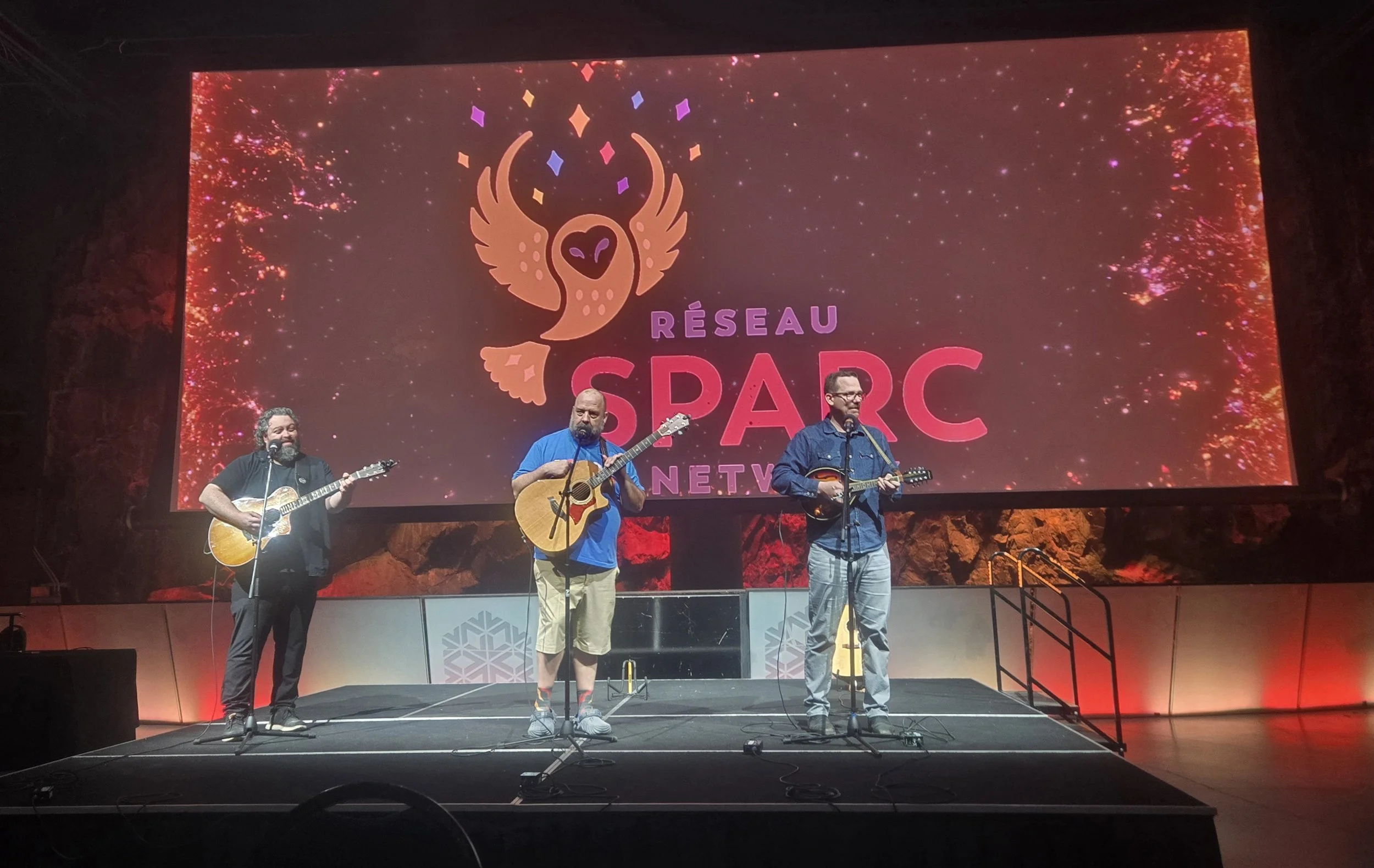
Image description: Three happy and casually dressed men each holding a guitar stand on a stage each behind a microphone in a dimly lit room in front of a screen with the Réseau SPARC Network logo on it. The logo is a golden cartoon owl with multi coloured diamond sparks coming from it and the words Réseau SPARC Network underneath it. The men are the band The Bilinguish Boys.
Seeking connection and inspiration in a large metropolitan city with multiple museums, collectives and organizations is an easier feat than for those of us in smaller rural communities with limited curated resources. Smaller towns do not have vast artistic communities making it harder to ebb and flow through circles. The Réseau SPARC Network has done an incredible job of curating a community of like minds and building camaraderie amongst multiple artistic disciplines giving an endless stream of resources, support, and inspiration to draw from. Their symposiums bring folks together with the passion of creation in mind and they build an artistic foundation where success is possible for any artist, no matter what challenges they may face and need to overcome.
The Réseau SPARC Network encourages us to work authentically, and to not mask up before building out the blueprint of our craft by giving space for each artist's strengths, weaknesses and barriers. SPARC encourages equal access by acknowledging barriers as a form of empowerment; When you can acknowledge and state your needs, you can also recognize the strengths in other people and can allow them to build their strengths into your project. This is one of the first things that I have learned from my experience with the SPARC community. I do not have to manage every single piece of the puzzle in my art. I can express my strengths and so can others. Reciprocity in art is a whole other blog post in itself.
Becoming part of the Réseau SPARC Network has assisted me in understanding different parts of the arts and how my skills are transferable across sectors. Building this network is something that I am passionate about being a small part of. Just like it was said in the 1989 fiilm, Field of Dreams, starring Kevin Costner, "If you build it, he will come." And selfishly, I am really enjoying working with and learning from the other artists I have met. I'm so excited to keep building.